
A Practical and Persuasive Guide for Restaurant Booths and Sizing
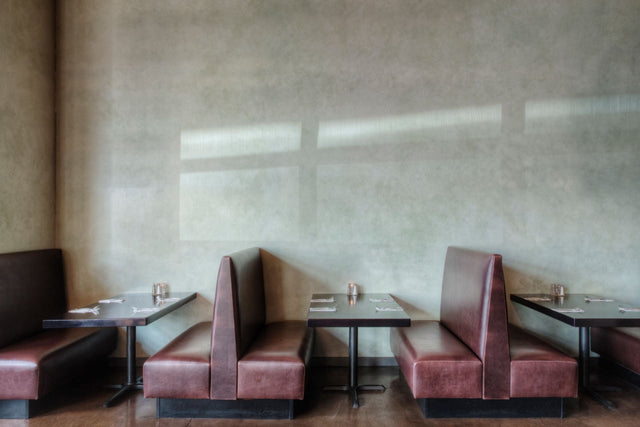
Key Takeaways
-
Restaurant booths are one of the most space-efficient seating options, often saving floor space compared to traditional tables and chairs.
-
Proper booth spacing and aisle planning improves service flow and allows staff to move easily throughout the dining area.
-
Standard booth dimensions typically include 36–48 inch back heights and 16–18 inches of legroom between the seat and table.
-
Booth and table sizes must be carefully matched to ensure guest comfort and balanced seating.
-
Flexible booth designs, including straight, half-circle, and banquette layouts, help restaurants maximize seating capacity while maintaining a comfortable dining experience.
When it comes to efficiency in nearly any restaurant setting, the dining booth, as a result of its unique dimensions and design, is often the wisest choice for seating, due to a variety of reasons, all of which we will touch upon shortly.
However, the tedious process of procuring that perfectly luxurious and aesthetically pleasing restaurant booth which also boasts the size and width necessary to accommodate your particular space, can be quite a challenge.
Thorough planning, measuring, and precision must dictate the process of restaurant booth spacing within the overall venue design. Restaurant bench dimensions and booth table size must be aligned just right so as to allow for the unrestricted comfort of guests as well as wait staff, and perhaps of equal importance, to allow for the maximizing of space in your dining area as well.
With so many potential benefits and advantages over standard restaurant seating dimensions, it would seem almost heartless for us to deprive hard-working and dedicated restaurateurs of a practical guide to restaurant banquette booth dimensions, as well as neglecting to sing their innumerable praises and merits.
It is in this spirit that we present the following guide for restaurant banquette booth size and dimensions, while simultaneously proving how unbelievably advantageous it could be over standard restaurant seating arrangements and their troublesome dimensions.
Restaurant Booth Spacing
Firstly, it is of the utmost importance to understand the sheer practicality of dining booth dimensions in any setting. To start with, it makes the task of serving with alacrity and efficiency, a simple one that is only threatened to become increasingly complicated with the addition of tables and chairs.
The neat and orderly rows produced by sets of booths, allows staff the spacing to move about in straighter paths without the difficulty of maneuvering around four sides of every table. Furthermore, overall traffic throughout the venue is significantly reduced, making it more spacious and roomy in general; a fact that benefits everyone on premises.
The additional spacing provided by restaurant booth bench and table dimensions, as opposed to the measurements of classic chairs and a table, can save over ten square feet of space per party of four. This means that your venue will be capable of accommodating more patrons at a time, another invaluable feature.
A Private and Intimate Dining Experience
Restaurant booths also allow diners to enjoy their meal with more privacy, greater comfort, and even a touch of intimacy as a result of their distinctive design.
Bench backs contribute significantly to the privacy and comfort of any dining booth. Standard heights from the floor to the top of the bench back are 36, 42, and 48 inches, while the seat itself, in order to comfortably accommodate all guests, should generally allow for around 16 to 18 inches of space from beneath the tabletop to the seat.
Restaurant Booth and Table Width and Depth
Booth and table width must align as well in order to thoroughly reap all the benefits of booth seating in your restaurant. The industry standard widths for booth benches are 24 and 30 inches for a one person bench, 44 and 48 inches for a two person booth bench, and 60 inches for a bench that accommodates three individuals.
When determining the length and width of the accompanying table, it is imperative that the bench dimensions and table dimensions operate in harmony and with careful consideration of all spatial aspects from the customer’s perspective.
To accommodate larger groups as well as certain, more unique spaces, consider investing in half-circle and ¾ circle booths as well. They are of equal comfort and elegance to their straight-sided counterparts, and generally speaking, just as efficient.
The Bottom Line
In summation, whether you’re starting a fresh and exciting new restaurant, or simply in desperate need of a sweeping, all-encompassing change, one that can alter the entire course of a restaurant’s destiny with a singular, powerful blow; booth seating is an option to be seriously weighed.
Increased profits and traffic, unmatched customer satisfaction, employee satisfaction, incomparable efficiency; these are all tremendous gains that await the restaurateur who is ready and willing to make that bold, informed decision.
The Chair Market, in addition to a true appreciation for the many rewards of restaurant booth seating, has a thorough grasp, extensive knowledge, and incomparable expertise when it comes to helping pair a venue with the most exquisite, practical, comfortable, and accommodating booths for its own distinctive and unique features.
FAQ
What are the standard dimensions for restaurant booths?
Standard restaurant booth dimensions are designed to balance comfort with space efficiency. Booth backs typically measure between 36 and 48 inches high, while the seat height is generally around 18 inches from the floor. The distance between the seat and the tabletop should allow approximately 16 to 18 inches of legroom so guests can sit comfortably. Booth bench widths commonly range from 24 to 30 inches for single seating and up to 60 inches for larger booths.
How much space should be left between restaurant booths?
Proper spacing between restaurant booths is important for both guest comfort and smooth service flow. Most restaurant layouts allow at least 18 to 24 inches of aisle space between booth rows so diners can enter and exit their seats comfortably. In busy dining rooms, wider aisles may be used to allow servers to move quickly while carrying food and beverages without interrupting guests or creating congestion.
Why do many restaurants prefer booth seating over tables and chairs?
Many restaurants prefer booth seating because it maximizes available floor space while also improving the dining experience. Booths are typically arranged along walls or in organized rows, reducing the circulation space needed around each table. This efficient layout often allows restaurants to seat more guests in the same area while offering diners greater privacy, comfort, and a more relaxed atmosphere compared to traditional tables and chairs.
How do you choose the right table size for a restaurant booth?
Choosing the right table size for a restaurant booth requires careful coordination between the booth width and the table dimensions. The table should fit comfortably within the booth seating area while leaving enough space for guests to move and dine easily. Two-person booths typically use tables around 24 to 30 inches wide, while larger booths require wider tables to maintain proper spacing and seating balance.
What types of restaurant booth layouts are available?
Restaurant booths come in several configurations that allow owners to adapt seating to their floor plan and guest needs. Common layouts include single booths placed against a wall, double booths arranged back-to-back, and banquette seating installed along long sections of wall space. Some restaurants also incorporate half-circle or three-quarter circle booths, which can accommodate larger groups while creating a distinctive and comfortable dining environment.