
Banquet Hall Seating: What Your Supplier Isn't Telling You About Stackability

New York Showroom: 1357 Atlantic Ave, Brooklyn, NY 11216 | Hours: M-Thur 9-5pm, F 9-3pm | Phone: 718-363-3097 | Minimum order: 10 pieces
When a banquet chair supplier describes a chair as “stackable,” that is only the starting point.
For a banquet hall, hotel, country club, or function room, stackability affects far more than how many chairs can sit in one column. It influences storage space, employee workload, transport time, chair carts, setup and teardown, and the amount of damage your seating may experience between events.
A chair that stacks neatly in a showroom may still be difficult to move, too heavy for your staff, incompatible with your existing cart, or prone to scuffing when stored incorrectly.
Here is what to evaluate before you buy.
Storage Footprint
The first question is not simply, “How many chairs stack?”
The more useful question is: How much floor space will my complete inventory require, including access aisles and carts?
A typical commercial banquet chair may stack approximately 8 to 12 chairs high, depending on its frame, dimensions, and manufacturer rating. However, two chairs with the same stacking height can require different amounts of storage space because of differences in:
- Chair width
- Leg design
- Frame shape
- Seat and back thickness
- Stacking angle
- Required spacing between stacks
- Cart dimensions
For example, a supplier may tell you that a model stacks 10 high. That does not tell you whether 100 chairs will fit efficiently in your storage room. You also need to know the number of stacks, the footprint of each stack, the total height, and the clearance required for safe movement.
A practical estimate is:
- Divide your total chair quantity by the manufacturer’s safe stack height.
- Multiply the number of stacks by the footprint of one stack.
- Add room for aisles, doors, columns, carts, and access to other equipment.
- Keep stacks away from exits and required emergency pathways.
One storage guide recommends allowing approximately 36 inches of clearance around stored seating for movement and access. Always confirm your layout against applicable building and fire-safety requirements.
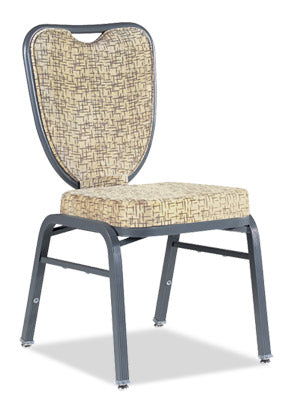
The The Chair Market banquet hall chair collection includes a wide range of stackable wholesale seating, including aluminum, Chiavari, upholstered, and faux-wood-look options. The correct model depends on both your room design and your storage limitations.
Transport Weight
A stackable chair can save space while still creating a handling problem.
This is particularly important when your team moves several hundred chairs multiple times each week. Staff may carry chairs from storage to the event room, move them around tables, return them after teardown, and load them for off-site events.
According to storage information published by Shelby Williams, an average stack of 10 steel banquet chairs weighs approximately 220 pounds, compared with approximately 140 pounds for 10 aluminum chairs. These figures are product-category averages rather than universal specifications, but they illustrate why frame material deserves attention.
Aluminum chairs can reduce the weight employees need to move, while steel chairs may provide a heavier, more substantial feel. Neither material is automatically right for every venue. The important point is to compare:
- Weight per chair
- Weight per stack
- Weight on a fully loaded cart
- Number of employees required for movement
- Distance between storage and function rooms
- Floor surfaces, ramps, and thresholds
Ask your banquet chair supplier for the actual product weight, not only the chair’s weight capacity. A chair rated to support a high load may still be unnecessarily difficult to handle if the frame is heavy.
Cart Compatibility
A chair cart is not a universal accessory.
The wrong cart can leave a stack unstable, cause chairs to lean, damage the frame, or increase the risk of tipping while crossing a threshold. A properly matched cart transfers much of the load to its wheels and makes long-distance movement more controlled.
When comparing carts, confirm:
- The exact chair models the cart supports
- Maximum chair capacity
- Maximum recommended stack height
- Cart width and turning radius
- Caster quality and floor compatibility
- Whether the cart protects upholstery and finished frames
- How the cart handles ramps, doorways, and uneven surfaces
A handhold or integrated grip is also useful. It allows employees to control the chair without pulling on the upholstery or placing dirty hands on the seat and back.
For a venue with limited storage space, a vertical cart may be more efficient than several loose floor stacks. For a venue that frequently changes room layouts, a mobile cart can improve setup speed even when storage capacity is not the primary concern.
Do not wait until after purchase to ask about carts. A reliable banquet chair supplier should be able to discuss compatible transport equipment as part of the seating specification.
Setup Efficiency
Stackability affects labor every time a room changes configuration.
A venue may need classroom seating in the morning, banquet rounds in the afternoon, and an open dance floor in the evening. If chairs can be moved in stable, manageable stacks, your team can complete these transitions with less carrying and less unnecessary handling.
Look for chairs that:
- Nest consistently without forcing the frames together
- Remain straight when stacked
- Have smooth, aligned legs
- Include a practical handhold
- Can be moved safely on a compatible cart
- Are easy to remove one at a time
- Do not require excessive force to separate
The most space-efficient chair is not always the fastest chair to use. A very high stack may reduce floor space but become difficult to reach or control. A slightly lower stack may be more practical for daily operations.
Your supplier should help you test the chair in the way your staff will actually use it. Stack the chairs, move them on the proposed cart, turn corners, pass through doorways, and separate individual chairs. A showroom demonstration should reflect your operating conditions.
Damage Control
Poor storage can shorten the useful life of otherwise durable banquet hall seating.
Damage often occurs when chairs are dragged across the floor, stacked unevenly, placed on an incompatible cart, or pushed through tight storage areas. Repeated contact between frames can create scratches, bent legs, loose fasteners, or damaged upholstery.
To reduce avoidable wear:
- Never exceed the manufacturer’s rated stack height.
- Keep each stack straight and fully seated.
- Move large quantities with a suitable cart or dolly.
- Do not drag chairs across finished floors.
- Avoid placing heavy equipment on chair stacks.
- Keep fabric and upholstery away from damp storage areas.
- Inspect legs, welds, screws, glides, and upholstery regularly.
- Follow the manufacturer’s recommended cleaning products.
Storage conditions matter as well. Humidity can contribute to rust, odor, fabric deterioration, and damage to wood finishes. Keep chairs in a dry, ventilated area and avoid blocking access to other equipment.
The Chair Market states that its commercial banquet hall chairs come with a 12-year guarantee. Ask for the specific terms that apply to the model you are considering, including coverage for frames, finishes, upholstery, and replacement components.

Stackable Options
Stackable banquet chairs are generally the practical choice for venues that frequently convert rooms or store high quantities of seating.
They can provide:
- Lower storage requirements
- Faster room changes
- Easier inventory organization
- Better compatibility with chair carts
- More efficient transport between rooms
- Flexible use for banquets, conferences, ceremonies, and training sessions
Aluminum stack chairs are often worth considering when employee handling and transport weight are major concerns. Fully upholstered models may be more appropriate when guest comfort and a formal appearance are priorities. Wood-look aluminum chairs can offer a traditional visual style with a lighter frame.
The key is to evaluate the complete operating system: chair, stack height, cart, storage room, staff workflow, and maintenance requirements.
Nonstackable Options
Non-stackable or limited-stack seating may still be appropriate in some settings.
A fixed chair, specialty dining chair, or larger upholstered armchair can suit a venue where:
- Chairs remain in place most of the time
- Storage space is not limited
- Seating is used for permanent dining layouts
- The design requires arms or a larger profile
- Guest comfort takes priority over rapid room conversion
The disadvantage is operational. Non-stackable chairs usually occupy more floor space and may require more individual handling. They can also limit how quickly your team can clear a room after an event.
If your function room changes layout regularly, compare the long-term labor and storage costs before choosing a model based on appearance alone.
Supplier Questions
Before placing an order, ask your banquet chair supplier for written answers to these questions:
- What is the manufacturer’s safe stacking height?
- What is the exact weight per chair and per stack?
- What is the floor footprint for 50, 100, and 200 chairs?
- Does the chair require spacing between stacks?
- Which carts or dollies are designed for this model?
- What is the loaded cart capacity?
- Can the chair be moved safely across carpet, tile, concrete, ramps, and thresholds?
- Are replacement glides, fasteners, upholstery, or frame components available?
- What cleaning and storage conditions are recommended?
- What warranty or guarantee applies to commercial use?
A supplier that cannot provide this information may be selling a chair based on appearance rather than venue performance.
Buying Checklist
Bring your storage-room measurements and event requirements when you shop. Include:
- Total chair quantity
- Typical guest count
- Function-room dimensions
- Door and elevator measurements
- Storage-room dimensions
- Distance from storage to event rooms
- Floor surfaces and thresholds
- Number of staff available for setup
- Frequency of room changes
- Need for carts, dollies, or off-site transport
The Chair Market has supplied seating to the hospitality sector and institutions for over 50 years. Our family business offers more than 500 in-stock styles, including commercial banquet hall seating with wholesale pricing for hospitality businesses, interior designers, and architects.
Visit the banquet hall chair collection to compare available styles, or browse commercial seating for additional options.
New York Showroom: 1357 Atlantic Ave, Brooklyn, NY 11216 | Hours: M-Thur 9-5pm, F 9-3pm | Phone: 718-363-3097
Don’t miss out on the details that affect your daily operation. Check the stack height, storage footprint, transport weight, and cart compatibility before you approve your next banquet seating order.